Is Validation Getting In The Way?
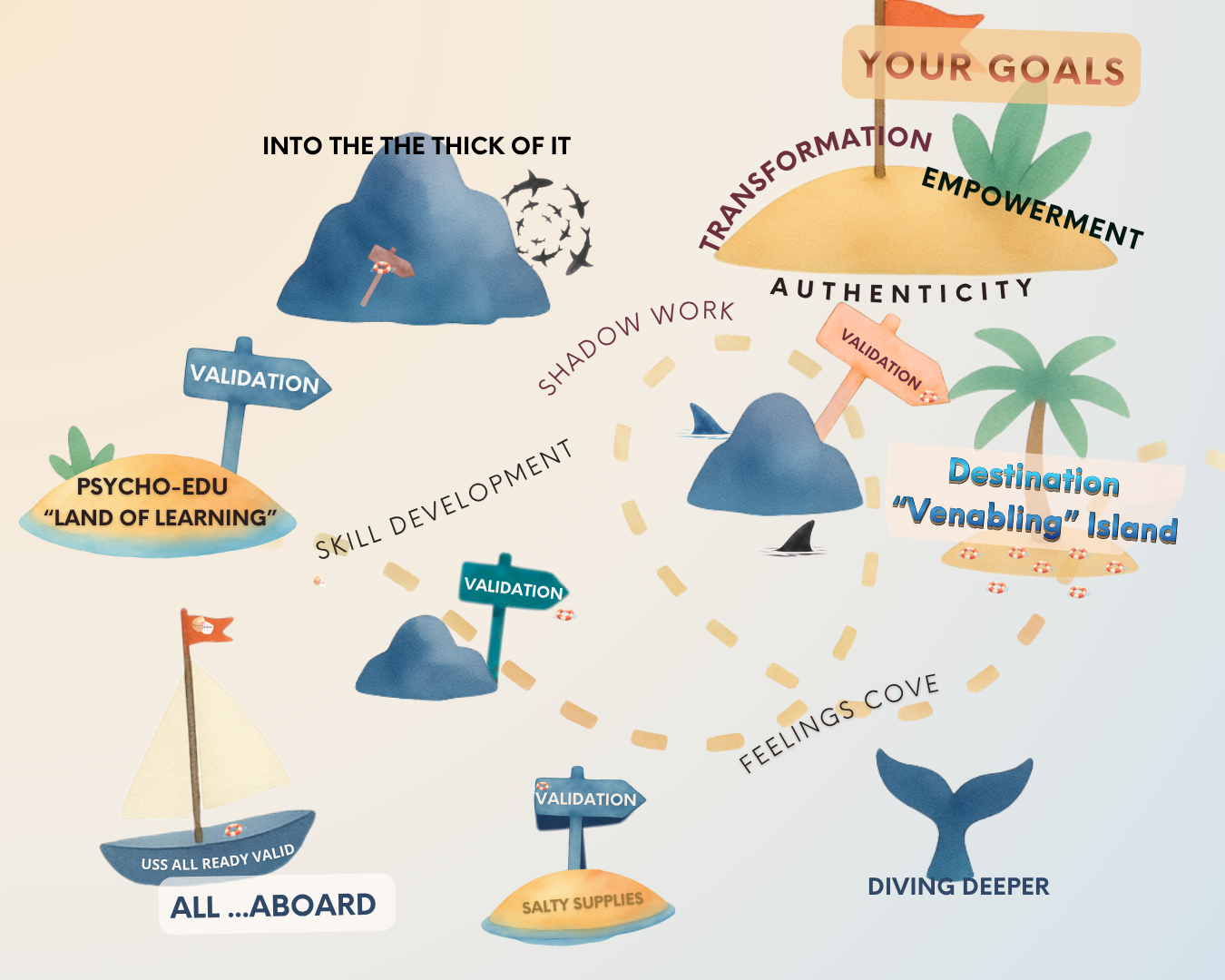
As promised, I’m back with “more” insights from my previous blog on Change and Transformation. In this post, I’ll clarify what I view as the limits of validation, how I define venabling, why I see the stages of change as a map, and share my personal approach to therapy, including how I manage and embrace my limitations as a therapist.
Validation opens the door and supports the frame
In the therapeutic setting, validation is often essential for building trust and creating a safe, supportive environment for care and connection. It reinforces the relational framework throughout the process, not just in the initial stages. For many clients, especially those with complex histories, a validating therapeutic alliance may be one of the few, or even the only, experiences where their feelings, experiences, and responses are truly acknowledged.
Sharing our true feelings and receiving understanding from a professional rather than judgment can be very comforting and empowering. When a therapist says, "That was messed up,” or acknowledges your frustration and recognizes abuse, it reaffirms your worth and humanity. Over time, this external validation helps build greater self-trust and inner confidence.
So, what does this look like in a session?
It often involves a therapist gently challenging a client’s limited view to help them move beyond just agreeing and towards greater emotional maturity, regulation, and empowerment. For example, a client might see herself as misunderstood and blame others as the problem. But when she feels safe enough to consider she might also be part of the issue, she can recognize her own behavior, even if she once thought it was bad, without feeling her worth is lessened.
*Is there ever a season where validation alone IS the treatment?
There are delicate situations where validation is prioritized. The following are some examples. When someone is navigating grief and loss, particularly during the initial 12 to 16 months (or longer in specific situations), it is appropriate to focus primarily on validating emerging emotions and processing the loss. Also, recent experiences or disclosures of abuse and trauma may require spending significant time creating a sense of safety.
There's a word for what happens when validation never graduates
Venabling
(I coined it and I stand by it.)
Venabling refers to the act or process of endorsing an individual beyond rational explanation or providing constructive support. It involves cultivating a culture and dynamic in which validation becomes the primary, if not sole, method through which an individual perceives emotional and interpersonal safety and support. The absence of unequivocal validation is regarded as a threat, betrayal, or justification for terminating the relationship, prompting the reconsideration of all previous validation as potentially unauthentic. Those who are venabled perceive no necessity for introspection or character development that involves acknowledging personal errors or shortcomings.
Venabling and Self-Aware Client
Venabling can be a subtle phenomenon for both client and clinician. Neither intentionally enters this dynamic. Yet even therapy-savvy, self-aware clients find themselves comfortably venabled.
It’s common for new clients to start therapy with sophisticated language, often asking for help with coping skills, boundaries, emotional regulation, and reducing symptoms. These goals are positive and useful.
However, beneath these initial strategies often lies a pattern of externalizing the problem. While a self-aware client actively seeks solutions and understands concepts, they often blame their distress on external factors like people, organizations, or policies. For example, they might find certain settings or individuals trigger their anxiety and want to react better or feel nothing when dealing with difficult co-workers or family members.
This awareness usually includes recognizing their triggers and patterns in others. The key point is that they tend to see their distress as caused by outside influences; they believe people or circumstances are the problem, and that life itself ‘just can’t seem to get it together.’ As a result, they focus on coping or regulation strategies. (Externalizing is a common pattern early in therapy, and even early in life, as we develop.)
Self-aware clients who are prone to confusing validation with enabling often display the following features when recounting interactions they report as challenging:
The client is frequently on the receiving end of others who have behaved selfishly, unfairly, or thoughtlessly.
The client expresses disproportionate, if not distressing, incredulity when trying to understand others' motives and behavior, as they would never behave in such a way.
The client is extremely confident in their inherent altruism and lack of self-seeking malice or impropriety (situationally or in general).
The client tends to maintain an unexamined and/or unchallenged belief that their personal standards, ascribed social norms, and values (conscious and unconscious) are “correct” and desirable, if not morally, emotionally, or cognitively superior.
The client may identify a specific issue, such as a problematic relationship or situation, yet there’s often a broader sense of being “exceptional” in their life. Beyond the problematic boss or friend, the client views most people as lacking. The people at work are okay, but no one is as hardworking or organized as they are. Even the knitting circle members are friendly, yet none are as considerate or thoughtful as they are.


Again, externalizing, particularly early on, isn’t a moral failing (nothing noted in this blog is). The aforementioned also isn’t a random jab from a therapist at those who believe themselves to be self-aware.
As the good brother, Prophet Sy Sperling (RIP), told us, “I’m not only the President, I’m also a CLIENT!” Long before I was a therapist, I was a client (and still am). I’m a woman diagnosed with ADHD later in life, and my longest, clearest thread of social recognition, achievement, and material survival has been my intellectual resources and abilities. Intellectualizing and being “self-aware” was my bread 🍞 and butter 🧈… and a sister still likes toast from time to time. I have also unwittingly reached for venabling and called it validation in my personal life.
I believe Anaïs Nin’s quote: “We don’t see things as they are, we see them as we are.” Therapy can offer a nonjudgmental space to explore who we are, while having our feelings acknowledged and normalized.
It often takes several regular sessions to establish a nonjudgmental, respectful, and accepting environment where clients feel heard and experiences acknowledged. This enables exploration and processing of harm, potentially sharing psychosocial education about human development, nervous system functions, socialization, and cultural norms influencing thoughts, feelings, and behaviors. The clinician observes the client’s tolerance and checks on their experience throughout.
Yet for some self-aware clients, prompts that encourage exploring internal motivations, broadening perspectives, and practicing assertiveness and boundaries can lead to resistance.
Even after sessions filled with respect, validation, insight, openness, vulnerability, humor, and enjoyment, a self-aware client might retreat when asked to question their internal beliefs and unconscious limits. They may be skilled at managing external behaviors, such as others' patterns, therapy language, or social norms. Self-awareness does not mean being inherently self-experienced.
A self-aware person may lack deep understanding of their internal experience, including identity, unconscious aspects, and core values, which are often treated as universal guidelines. If their framework involves dichotomous thinking or zero-sum logic, being asked to consider other ways of thinking may be perceived as invalidating or dismissive and, if unaddressed, as an existential threat.
In session, the client may retreat into moral superiority, claiming clairvoyant knowledge that things won’t work out, and resigning to expecting less, as they believe most people won’t meet their standards. They might shut down, cross their arms, or complain about not feeling validated. The session may stall until the therapist points out the other’s faults and the client’s frustration.
Such responses don’t occur in a vacuum; the client is likely overwhelmed, possibly from a life of constant demands and minimal support. Their upbringing might have taught them that people are either good or bad, right or wrong, and survival may have prioritized self-protection over introspection. These experiences are valid. However, validating them to the point of enabling won’t foster meaningful healing, change, or transformation. At best, it offers temporary relief. True change requires deeper introspection and action.
Quick Check:
Venabling can look like:
A therapist who has proven himself or herself to be validating and consistent, sharing an uncomfortable truth or alternative perspective about a client’s behavior, interaction, or dynamic, and the client is immediately offended.
Most, if not all, of a client’s sessions are considered a success only if the client feels vindicated about their choices, actions, and thoughts.
The client considers session attendance as the primary "doing the work" of therapy or using “being in therapy” as moral, emotional, or psychological high ground when dealing with others, i.e., friends, family, and co-workers.
Bonus: A therapist must constantly recalibrate their message to the point of being ineffective or inauthentic, for the client to tolerate.
VENABLING ISLAND: Cozy, “safe”, and not quite the intended destination.
What can venabling cost a client?:
A feeling of wasted time. Clients who require venabling at some point often end up saying, "I feel like all I do is vent."
Concepts without competency: Clients who have the language of therapy without embodying the practices, i.e., emotional maturity, sonder, etc.
A pristine (and unused) tool kit: Chasing a new tool skill or approach for every “new” cycle of emotional distress, interpersonal challenge
On the topic of Venting:
When clients say, “I need to vent today” or “I’ve been holding this in and need to get it out,” I’m genuinely pleased. It’s necessary. Such honesty shows emotional clarity and intelligence we aim for. If a client needs to decompress through action, I honor that. I usually structure venting for 7 to 10 minutes within the session. How we move forward depends on the person and situation. Our goal is to uncover deeper feelings, memories, or beliefs beneath frustration or the story.
A map is not the motor
In my last post, I mentioned Prochaska and DiClemente's stages of change: Precontemplation, Contemplation, Preparation, Action, Maintenance, Termination, and, for some, Relapse.
I view this model as a map, not an engine. Being in Contemplation doesn't mean you'll automatically move to Preparation or the next step. If it were like an engine, you'd expect every change you truly contemplated to effortlessly and eventually get us to action and maintenance. Yet, that’s not how it goes. The map shows your current location. It doesn't make you move.
In the therapeutic setting, action may be conflated with attendance and subsequently claimed prematurely.
Some believe that simply attending therapy and sharing their therapist’s perspective and insights with their partner or family member equates to “practicing assertive communication”, “active listening”, “setting boundaries”, and “emotional regulation”.
For example, a client saying, “I told ___ what you said, and they just got more upset,” may show they aren’t taking responsibility for their desires, expectations, and role. Therapy can’t happen through osmosis or for someone else. Insights must support the client’s growth. Changing dynamics doesn’t occur automatically by passing along advice or trusting the therapist’s authority. Such interactions are often disguised contemplation.
Genuine preparation might not be glamorous, but it’s essential.
Preparation might look like starting by saving money, reviewing the financial realities if your goal is to start a business or travel the world.
If you desire to improve your health, you may want to start by scheduling a physical, getting labs done, and keeping an honest log of activity and nutrition.
Changing harmful habits may start with establishing a trustworthy, reliable accountability partner.
Though preparation can seem boring and unimportant, it significantly affects how smoothly the transition into action unfolds.
Regarding relapse, see it as a reminder, not a setback. It doesn’t erase progress; muscles remember. Life’s pull may need readjustment, but the knowledge stays. Change and growth happen gradually. Healing isn’t a sudden change but a process, and relapse isn’t negative. Well-done contemplation helps prioritize what to address.
If you're in precontemplation, there might not be anything you need to do right now. It could be more like noticing: you see habits or issues in your life, relationships, or finances that may be problems or affecting your quality of life. Simply recognizing this is the first step.
Why I don't marry one framework
As you may have noticed, I didn’t go into much detail about action and maintenance in the previous section. In the next blog, I’ll explore how action and maintenance can appear through the following models of change:
Neuroplasticity and Co-Regulation, the neuroscience of change: Hebbian plasticity and Stephen Porges' Polyvagal Theory suggest change happens by rewiring neural pathways and calming the nervous system. The adult brain can build healthier pathways by processing emotion and practicing new habits in calm, safe settings.
Relational Frame Theory (RFT): Change happens not by deleting thoughts, but by dropping the struggle and taking meaningful action.
Social Constructionism and Post-Structuralism: Change occurs when they step outside their struggle story and reframe their identity around their strengths.
Decolonized and Liberation Therapy: True change occurs when we view healing as part of a broader effort to transform society.
Let me acknowledge the validity of the single-framework therapist approach, especially when a specific concern like a symptom and its cause significantly impacts a person's life, making a focused framework logical. For example, someone with borderline personality disorder affecting romantic relationships might benefit from a year of DBT. As a clinician working mainly with women and women of color, I often question the evidence behind "best practices,” who they’re based on, and how they're evaluated.
The person in front of me isn’t just a diagnosis. A client’s daily life, responsibilities, culture, community, location, politics, economics, and social trends influence how much time, energy, and resources she can dedicate to care and specific approaches. If the client outright refuses or dislikes a framework, it’s a sign it may not be effective now, not necessarily that it’s bad or won’t work eventually.
Being eclectic doesn't mean lacking focus, reflection, evaluation, or accountability. Adaptability involves tailoring the work to meet the client's needs and goals. In my view, unmoored simply means using a syllabus as a placeholder. In practice, adaptability means initially presenting the client with different frameworks and modalities, and clearly explaining which one is being used and why, as the process unfolds.
Referring out is care, not rejection
Sometimes accepting that I may not be the right fit is an act of honest adaptability. A client can be successful in action and maintenance, and the proper response for continued growth, change, or transformation may be a timely client-centered referral to someone who can better support the client at this juncture.
From the client's perspective, misalignment might feel like not being understood, invalidated, differences in temperament, or mismatched goals. It can seem like the clinician doesn't care about their feelings, is too directive, or not directive enough. Clients may also want the therapist to ease feelings or discomfort they don't yet fully understand.
From my perspective, I consider referring when a client resists self-reflection over time, when their symptoms or care needs exceed my scope, or when there’s a misalignment between practice interventions, approach, policies, and their needs and/or preferences.
I address this by asking clients how they feel about their progress and whether they're getting what they need from sessions. I share my observations, note my limitations, and express any concerns. I suggest other approaches or frameworks I’m not specialized in, ask for their thoughts, and answer questions. If they're open, I provide references and referrals.
Clients who have been “dropped” (I don’t like the term, but I respect the cultural and emotional relevance) by a provider and still carry that experience should understand that clinicians who genuinely care aim for clients to receive what they need from therapy, even if it's not with that particular provider. Keeping a client who isn't meeting their needs, growing, or healing does them a disservice.
Like all relationships, the therapeutic alliance can face complications, reach impasses, and sometimes require a shift in direction. Such issues are not a reflection of personal worth or value. Instead, they concern alignment and the client's best interests. Misalignment often appears early and cannot be resolved merely through improved communication or clarification of goals, roles, or approach. A rupture, however, involves more serious issues such as blatant disrespect or ethical violations by the clinician. Both situations merit discussion or at least attempts at clarity before ending the relationship.
I've received a referral myself and see it as a compliment, being trusted by the clinician and the client to give it a try. It showed me that therapy can be successful with different approaches. If you feel there’s a misalignment and your therapist doesn’t acknowledge it, bring it up. Therapy should be a safe space for practice. Therapists are experts, and clients are adults. Developing personal agency is key to growth. I encourage clients to share how they feel and make it clear that I won’t be offended if something isn't working.
At Nuanced Healing, when there is misalignment with fit, I refer them elsewhere based on their needs. Each client's process is unique; some continue their sessions until the referral is complete, while others leave abruptly without waiting. I always send a letter thanking them for their trust and providing general referral options like Therapy for Black Girls, Psychology Today, and Open Path.
Questions this may raise:
If none of these are your questions, skip ahead. If one is, here's an honest answer.
Q: “My therapist challenging me can feel like judgment. Why is that?”
A. I don't speak for other therapists, and I don't judge people I don't know. From my experience, a respectful invitation to grow highlights potential blind spots, encourages broader thinking, and asks you to consider larger patterns. It also invites you to access inner resources beyond initial emotional reactions or reasoning. Judgment, on the other hand, is about deciding what should or shouldn't be done, thought, felt, or said, based on personal values and standards that may not be shared. Judgment doesn't seek curiosity, growth, or healing.
Q: ”I'm exhausted. I don't have capacity for anything besides attending session.”
A. I believe you, and that's okay. It's important to share how much you can handle. If you're feeling overwhelmed and exhausted, expressing those feelings is completely human. I also want to share that meaningful change in your life and relationships outside of sessions will likely require changing the status quo. What that looks like should be unique to you and your overall goals.
Q: "What if I just want support right now, not transformation?"
A. That’s a great question. Support is the foundation of all work at Nuanced Healing. Right now, NH is seeking to work with clients who, at some point in the foreseeable future, are clear that healing and transformation are what they want and need.

Becoming a skillful sailor
In my last post, I mentioned that the goal is not to merely long for smooth seas, but to become a skillful sailor. That doesn’t mean one’s environment or weather doesn’t matter. Yet even when the tides are not in our control, we can develop the following skills for navigating them.
First, strengthening your vessel by checking for energy leaks and repairing them. Your physical, emotional, mental (and, if you so align, spiritual) vessel(s) all require care and maintenance. A leaky vessel will take on water in the calmest of seas.
Second, work with a crew: no one can do it all alone, and using the help available is essential. Whether that is a broader community, strategic connections, or supportive friends and family.
Third, understanding your emotional Geo-location, recognizing the patterns and external influences thereof. Ex. like seasonal changes, travel, or children returning to school, so you're not caught off guard by the predictable. If you're sailing in the Arctic, don’t be surprised by the cold.
And when possible, prepare for the truly unpredictable. What are your life vests? Emergency funds, stored PTO, a trusted friend to call, or a safety plan with your therapist. These are your safety gear for life's storms.
What to sail away with:
Support and validation are always available, but it’s just the starting point, not the limit!
I want to honestly express that I am passionate about working with individuals who are eager to take responsibility for their own growth and healing. Therapists, including me, specialize in supporting clients through all aspects and stages of their personal development. My particular current focus is on working with clients who are ready for intentional, deep work aimed at personal growth, self-mastery, and transformation.
Take some time to reflect on this: what do you truly believe about healing, change, and transformation? There are no right or wrong answers. We’ll explore more in part 3.

If you’re unsure about what you’re seeking or how to find the right clinician, our complimentary guide, Therapy Demystified, can help clarify it. You can access it when you sign up for our Nuanced NŪS letter.